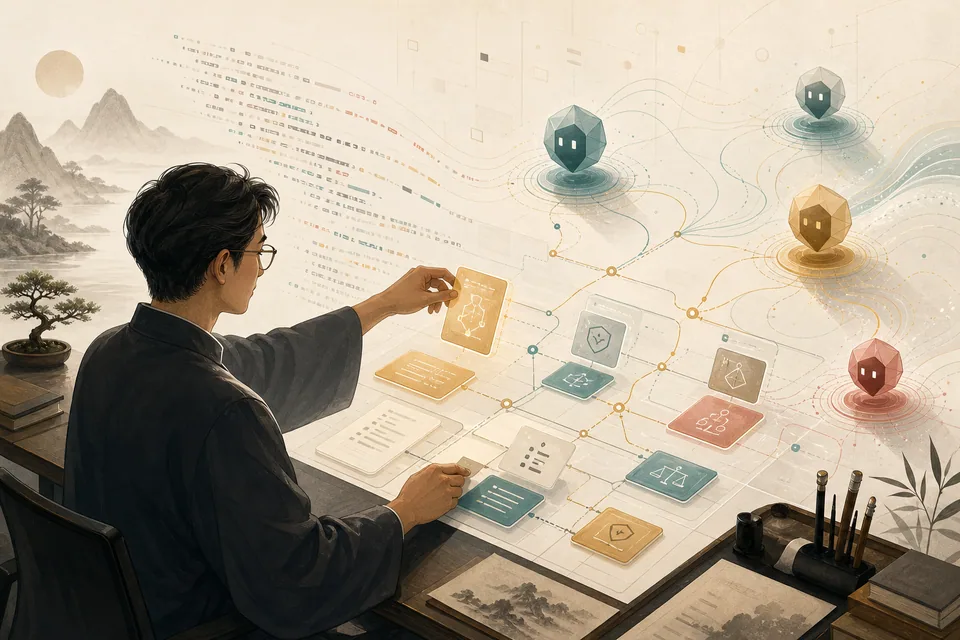
Software Organizations in the AI Era: From Multi-Person Teams to One-Person Organizations
A reconsideration of the organizational paradigm of software development.
1. Why Talk About Organizations Rather Than AI?
Over the past two years, most discussions about AI in software development have focused on tools:
- Can AI write code?
- Can AI improve development efficiency?
- Will AI replace programmers?
All of these questions matter.
But sustained practice has led us to an increasingly strong conclusion:
The biggest change AI brings may not be how software is developed, but how development is organized.
The question most worth discussing is not which AI tool will prevail, but this:
How will software development organizations evolve?
2. Three Stages in the Evolution of Software Development Organizations
Stage One: Solo Development
When software was smaller in scale, one person could handle product decisions, development, testing, and deployment. Organizational overhead was minimal.
As systems became more complex, however, the capabilities of a single individual became the bottleneck.
Stage Two: Multi-Person Organizations
This is the organizational paradigm that software engineering has built over the past several decades: complexity is managed through specialization and division of labor.
A typical workflow looks like this:
1 | Product → Design → Frontend → Backend → Testing → Operations |
Many of the theories and practices of software engineering—including:
- project management
- agile development
- DevOps
- microservices
- CI/CD
- software quality systems
are fundamentally attempts to answer the same question:
How can we organize more people to build complex software together?
Stage Three: One-Person Organizations
The emergence of AI agents is moving software development into a new stage.
In the future, a complex software system may no longer require a development team of dozens of people. Instead, it may be built by:
one organizational leader
coordinating:
multiple specialized AI agents.
At that point, AI is no longer merely a tool. It begins to take on responsibilities previously distributed across different roles within an organization.
The organization starts to converge around a new model:
One person governs; multiple AIs execute.
3. What Changes Is the Organization, Not Merely the Job
Many discussions ask:
Will AI replace programmers?
But in practice, the deeper change concerns:
how software organizations get work done.
In the past, organizations depended on collaboration between job functions. In the future, they may depend increasingly on coordination between agents. The human role is also being redefined.
In the past, people were responsible for doing the work. In the future, they may increasingly be responsible for organizing the work—a shift from:
“Do the Work”
to:
“Organize the Work”
4. A One-Person Organization Does Not Mean One Person Does Everything
The term “one-person organization” is easy to misunderstand. Does it mean that one individual must do everything?
No.
The real change is this:
Execution shifts from humans to AI.
One person, for example, might work with:
- a product agent
- an architecture agent
- a frontend agent
- a backend agent
- a testing agent
- an operations agent
Together, they form a new kind of software development organization.
The organization has not disappeared. Rather:
its members have changed.
5. What Must a One-Person Organization Actually Build?
If organizations become increasingly dependent on AI, what companies need to build is not simply more tools. They need new organizational capabilities.
An AI Governance System
Shared rules, consistent behavior, and common standards.
A Project Knowledge System
A way to accumulate and preserve knowledge over the long term.
A Context Governance System
A way to keep multiple AIs aligned around a consistent understanding.
Coordination Mechanisms
Mechanisms that allow multiple AIs to complete complex tasks together.
A Decision System
A system that keeps consequential decisions under human responsibility.
Together, these capabilities form:
the governance infrastructure of a one-person organization.
6. What Will Software Engineering Study Next?
For the past fifty years, software engineering has studied:
how to organize more people to build software.
In the future, it may increasingly study:
how to organize more AIs to build software.
Its object of study may evolve from:
Human Collaboration
to:
Human-AI Organization
and eventually even:
AI Organization
Software engineering may begin to move from:
Software Engineering
toward:
Organization Engineering
7. Why Is This Worth Exploring Now?
An organizational paradigm does not change overnight. The transition will unfold through a sequence:
1 | Tool Experiments → Local Practice → Organizational Adjustment → Institution Building → A New Organizational Model |
AI has already passed through the first stage and is now entering the second.
Over the next few years, organizational capability may become one of the largest sources of competitive differentiation between companies. The earlier an organization begins experimenting, the more opportunity it has to develop those capabilities for itself.
8. Conclusion
The Industrial Revolution amplified human physical strength.
The Information Revolution amplified our capacity to process information.
AI is now amplifying our capacity to organize.
In the past, companies competed over:
who could assemble more exceptional people.
In the future, competition may increasingly center on:
who can enable one person to govern an organization composed of AI agents effectively.
AI’s greatest impact on software development, then, may not be higher coding efficiency. It may be the emergence of a new organizational paradigm for software engineering.
Software engineering once answered:
How can we organize more people to build software?
In the future, it may need to answer a different question:
How can one person continuously and effectively govern a software organization composed of AI agents?
If software engineering emerged from the specialized division of labor of the industrial age, then software engineering in the AI era may emerge from:
the one-person organization.