
Modeling Thought Through Language: EchoPath Labs Is My First Step
My long-term goal is to model how people think through the words they express.
Writing leaves traces of how someone observes the world: what they notice first, how they define a problem, which evidence they consider important, how they choose between competing explanations, and what leads them to revise a judgment.
I want to understand these relationships gradually and develop models that people can revisit, question, and correct. Such models should help us understand our own decisions and help AI carry a person’s thinking forward through long-term collaboration.
EchoPath Labs is my first step toward that goal. I am starting with software engineering and human–Agent collaboration, where I can work on preserving the connections between expression, understanding, action, and feedback.
How words leave traces of thought
In my JanusPath writing, I keep returning to the relationships between observation, structure, and action. Different people can approach the same situation from very different starting points.
One person asks whether a result can be delivered faster. Another asks why the problem arose. Someone else first asks who has the authority to decide. These questions direct attention toward different things, influencing the evidence selected, the way the problem is divided, and the trade-offs considered.
When someone repeatedly explains their judgments in requirements, design discussions, code reviews, and retrospectives, those words offer several kinds of evidence:
- Attention and observation: What enters their view first?
- Concepts and relationships: Which concepts organize the problem, and what do they connect?
- Judgment and trade-offs: Why do they accept an explanation, and how do they handle conflicting goals?
- Revision and continuity: What changes when new evidence arrives, and what remains?
These are the things I hope to model over time. They need to be understood in context. A sentence might express a tentative idea or restate someone else’s view. A decision might reflect a deadline rather than a lasting way of thinking.
The model I envision therefore needs to retain sources, context, and uncertainty. The person concerned must be able to correct it, and later expressions and actions must be able to change it. Explaining one past choice is a starting point; whether the model remains useful in a new situation still needs to be tested.
Why begin with engineering collaboration?
Engineering work offers a relatively clear path for observation.
A person states a goal, explains the problem, and discusses constraints and trade-offs. An Agent acts on that understanding, producing changes, tests, and results. The person then judges whether the outcome matches their intent, sometimes redefining the problem along the way.
This creates opportunities to compare expression with subsequent action. When someone says “keep it simple,” do they mean fewer lines of code, lower effort for the user, or fewer things that a future maintainer must understand at once? The words alone tell us little. Their reviews of concrete proposals, the costs they accept, and their explanations of rework can make our understanding more precise.
I am starting here because these materials can arise through sustained work, with concrete outcomes available for comparison. Words provide an entry point; action and feedback help test our interpretation of them.
Engineering supplies only part of the evidence. It cannot represent how a person thinks in every other setting. Whether methods developed here can extend further remains an open question.
Before reaching that larger goal, I need to establish some foundations: where concepts come from, which judgments have been confirmed, whether actions respected the relevant boundaries, and how these connections can be recovered later.
The projects within EchoPath Labs have grown around these questions. EchoPath Labs names the family of projects. EchoPath is the individual product focused on cognitive continuity.
Five projects, each answering a question
Three words provide the main thread: meaning, action, and continuity.
OpenDomain concerns meaning: the concepts and rules of the world we are working in. RelayPact concerns action: how a task is delegated, executed, and accepted. EchoPath concerns continuity: why work reached its current state and how the next task can resume it.
ForgeRail supplies engineering governance around that thread. KeptNear supplies bounded credential-use capabilities.
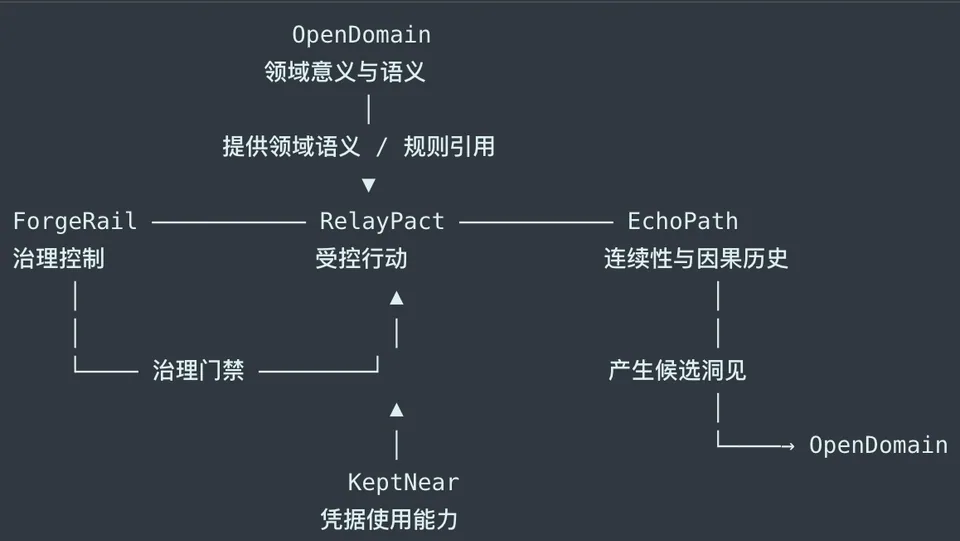
This diagram shows the responsibilities and intended composition I am building toward. It does not represent a fully integrated, automatically operating five-product system. Its Chinese labels describe domain meaning, governance controls, bounded action, continuity and causal history, credential use, and candidate insights.
OpenDomain: stable sources for concepts and rules
Consider an order-management system. Does cancelling an order imply a refund? Can an order be cancelled after shipment? These are questions about business meaning, and their answers need to survive beyond one conversation.
OpenDomain keeps long-lived domain concepts, rules, lifecycles, and evidence in Git-managed Markdown and YAML. Human maintainers and Agents can return to the same sources to check their understanding.
One distinction matters especially to me: accepted knowledge and unconfirmed inference must remain separate. An Agent can identify a possible rule in the code, propose it as candidate knowledge, and provide evidence. A plausible interpretation does not automatically become a business definition. The public implementation preserves the boundaries between candidate review and promotion into accepted knowledge. OpenDomain overview
ForgeRail: the engineering boundaries of the current task
Once the business meaning is understood, the work still needs an appropriate engineering process.
Which existing conventions apply? What may change? Which checks are needed? Which operations still require a person’s decision? ForgeRail starts with the workspace’s existing instructions, specifications, and evidence to give coding Agents proportionate guidance and constraints.
I want governance to fit the problem. A simple edit should stay simple. A change with greater risk needs clearer scope, validation, and handoff. ForgeRail’s public alpha follows this approach through progressive adoption. ForgeRail overview
RelayPact: bounded delegation with explicit acceptance
When part of the work can be delegated to another Agent, RelayPact makes the arrangement explicit: the task, permitted reads and writes, and the evidence that must accompany the result.
After the executor reports completion, the coordinator still needs to review the actual output. Completing execution, accepting a result, and applying changes to the source are separate steps. A completion message cannot replace scrutiny of the patch and its validation.
The publicly verified route currently runs from Codex to Codex. My interest is in making collaboration understandable, reviewable, and able to reach a clear conclusion. RelayPact overview
KeptNear: credential use within a specific operation
Some tasks require an API or an external service. That introduces another question: how can credentials be used without scattering raw secrets across prompts, conversations, and ordinary tool output?
KeptNear is a local-first password and token manager in its own right. Its role in this system is narrower: authorized use tied to selected credential fields, applications, and operations.
An available credential only establishes that a particular access capability is available. It does not approve the business operation or authorize a release. The Broker, MCP, and CLI capabilities remain source-level developer previews; this direction should not be mistaken for a complete machine-access workflow already delivered to ordinary users. KeptNear capability status
EchoPath: recovering understanding for the next task
EchoPath concerns what should remain after the work, and how it can be understood again.
A summary of what changed often leaves too much out. We also need the goal, evidence, choices, outcome, and unresolved differences. Project Compass is intended to help people and Agents recover the project’s current position, the reasons behind it, and the next useful action.
Causal history needs clear evidence boundaries. A file change or test result can be observed. Why a choice was made needs an explicit explanation or decision record. An interpretation without adequate support should remain reviewable rather than become unquestioned history. EchoPath works with workspace evidence, explicit Agent returns, and human confirmation.
The central loop I am working to validate runs from understanding and confirming a task, through execution and outcome review, to a recoverable conclusion that can support the next task.
Putting the pieces into one task
Return to the order-management example. The following is an illustrative scenario for the intended composition, not a demonstration of shipped five-product automation.
Suppose we need to change order cancellation.
We first consult the accepted rules in OpenDomain. If the sources do not establish what happens after shipment, we surface that gap for the responsible person to resolve. The Agent should not silently invent a business definition while implementing the feature.
EchoPath could help recover relevant history: earlier alternatives, continuing constraints, and evidence that needs checking again. A previous decision can help explain the present, but a past permission does not authorize the current operation.
ForgeRail then helps establish the modification scope, validation requirements, and operations needing confirmation under current project conventions. If part of the task is suitable for delegation, RelayPact hands it to an independent executor while retaining coordinator review. If external credentials are needed, the intended KeptNear integration supplies use within an approved scope. A task that needs no credentials has no reason to involve that part.
When results return, “tests passed” is only one piece of the review. Does the actual change satisfy the task? Were any behaviors missed? Which claims remain interpretations? Confirmed outcomes and unresolved questions become material for later recovery.
If the work reveals a more general domain rule, that insight can enter OpenDomain’s candidate review. Only after confirmation can it become knowledge that future tasks rely on.
A task can therefore leave behind clearer understanding as well as code. Experience enters the durable structure through review.
Why the projects should remain independent
I describe the design principle as Composable Autonomy: each product solves a complete problem independently, with composition occurring through explicit interfaces and evidence boundaries.
Someone maintaining business concepts should be able to use OpenDomain alone. Someone delegating work can use RelayPact independently. KeptNear has its own value as a password manager. EchoPath’s continuity work should also be able to include actions that did not pass through RelayPact.
Independence requires respecting responsibilities. An engineering check cannot approve domain knowledge. Accepting an execution result cannot authorize publication. Recording the history of an authorization cannot establish that it remains valid now.
In the composition I am designing, products exchange results and evidence references with sources and versions. The product responsible for a fact continues to maintain it. When an integration is missing, the absence and its consequences should be explicit. Failing to retrieve history must not be interpreted as proof that no history exists.
This structure should allow the tools to evolve separately and let people adopt only the parts they need.
Where the work stands
As of September 7, 2026, the projects are at different stages:
| Project | Current progress |
|---|---|
| OpenDomain | v0.1.0 stable is published, with domain modeling, validation, candidate review, and context export. |
| ForgeRail | The current public prerelease is v0.1.0-alpha.4. Codex is the verified host. |
| RelayPact | v0.1.2 Public Preview supports the public Codex-to-Codex delegation and review path. |
| KeptNear | v0.1.0-prealpha.2 is experimental. It has not received an external security audit and is unsuitable for production credentials; machine access remains a developer preview. |
| EchoPath | Local development and validation in its own workspace continue, focused on the complete cognitive continuity loop. |
Individual implementations and validation work exist, while the full cross-product connections still need to be established. This is another reason to preserve independent boundaries: let concrete capabilities encounter real use before deciding which connections deserve to become stable.
From collaboration records to revisable models of thought
These tools are laying foundations for the larger modeling effort: concepts with sources, explicit task intent, inspectable outcomes, and recoverable histories of judgment.
Further questions remain. How can expressions across tasks reveal relatively stable ways of thinking? How do we distinguish lasting tendencies from situational choices? How can we tell whether a model improves understanding rather than merely attaching a plausible explanation to past words?
I want the person concerned to see the basis of a model’s interpretation, to say “you misunderstood,” and to explain “I have changed my mind.” A model of thought needs to accommodate changes in thought itself.
EchoPath Labs has not yet achieved that complete modeling capability. Composition among the projects is also still in progress. Each tool first needs to demonstrate value in its own concrete problem before it can provide a reliable foundation for the larger exploration.
For me, this path brings JanusPath’s interest in observation and structure into something that can be built and tested.
I want to follow the words a person leaves behind and gradually understand how they form problems, judgments, and choices, then test that understanding against new expression and action. EchoPath Labs is where that exploration is beginning to take practical form.
The public projects are available through the EchoPath Labs GitHub organization.