What You See Is Not the Problem Itself, but the Way It Becomes Visible
Much of the time, we believe we are solving a problem.
The more accurate description may be that we are working inside a problem that has already been organized for us.
Consider a delayed project. On the surface, “someone failed to deliver on time.” We naturally ask: Who was responsible? Who delayed the schedule? How do we prevent it next time?
Those questions are meaningful. But they remain at the level of content. Look deeper and the delay may have arisen from unclear responsibility boundaries, no entry point for changing requirements, a mismatch between resource commitments and actual capacity, or a team habit of pushing uncertainty into the final stage.
The question is no longer simply “Who failed?” It becomes:
How did the structure produce this problem?
That is what JanusPath originally set out to address.
1. Do Not Ask Only What Happened; Ask Why It Happened in This Form
The central proposition of JanusPath’s first paper, The Janus Path: A Structured Cognitive Model, can be summarized in one sentence:
Structure precedes content.
The events, opinions, conflicts, and choices we encounter do not appear in isolation. Behind them is a set of relationships, boundaries, positions, tensions, and feedback mechanisms that determine what will be visible, what will be ignored, and what will be treated as natural.
At the content level, an argument in a meeting is an emotional conflict. At the structural level, it may be an imbalance between authority and responsibility.
At the content level, a failed product has poor features. At the structural level, the target users, business model, and organizational resources may never have formed a stable loop.
At the content level, a person repeatedly making similar choices has a personality problem. At the structural level, they may have spent years inside a particular system of relationships, language, and evaluation, learning to explain themselves in the same way.
JanusPath therefore trains us not to answer more quickly, but to pull the problem back from content to structure.
It forces us to ask uncomfortable questions:
- Am I facing the problem itself, or a problem someone else has already packaged for me?
- Am I applying the right method inside the wrong structure?
- Who drew the boundary around this problem?
- Which tensions have been concealed by language?
- Am I also reproducing this structure?
This is structural reflection.
It is not ordinary analysis. It looks back at the way a problem was generated.
2. Why Is Janus Two-Faced?
Janus is the two-faced god of ancient Rome, looking toward the past and the future. JanusPath borrows this image not to mythologize a model, but to express a cognitive posture:
A person acts within a structure while looking back upon it from outside.
This is the dual perspective.
Someone who remains only inside a situation is easily swept along by immediate emotion, interest, role, and pressure. Someone who remains only outside may become a cold observer, insensitive to the reality people inhabit.
JanusPath tries to preserve both capacities.
On one hand, enter the scene and see the actual people, events, constraints, and pain.
On the other, step back and observe how relationships are arranged, boundaries are drawn, and tensions move.
This is more difficult than simply “being objective.”
You must admit that you are inside the situation while seeing how the situation came to exist.
3. But Structure Is Not the End
If JanusPath stopped here, it would already be a method of structural thinking.
A new question soon emerged:
If content is organized by structure, how does structure become visible to us?
Different people can see entirely different structures in the same event.
When a project is delayed, an engineer may see system coupling. A project manager may see a process out of control. An executive may see a broken chain of accountability. A customer may see a broken promise. Someone who has been exhausted for a long time may first feel disrespected.
None of these views is imaginary.
But they are not views of the same structure.
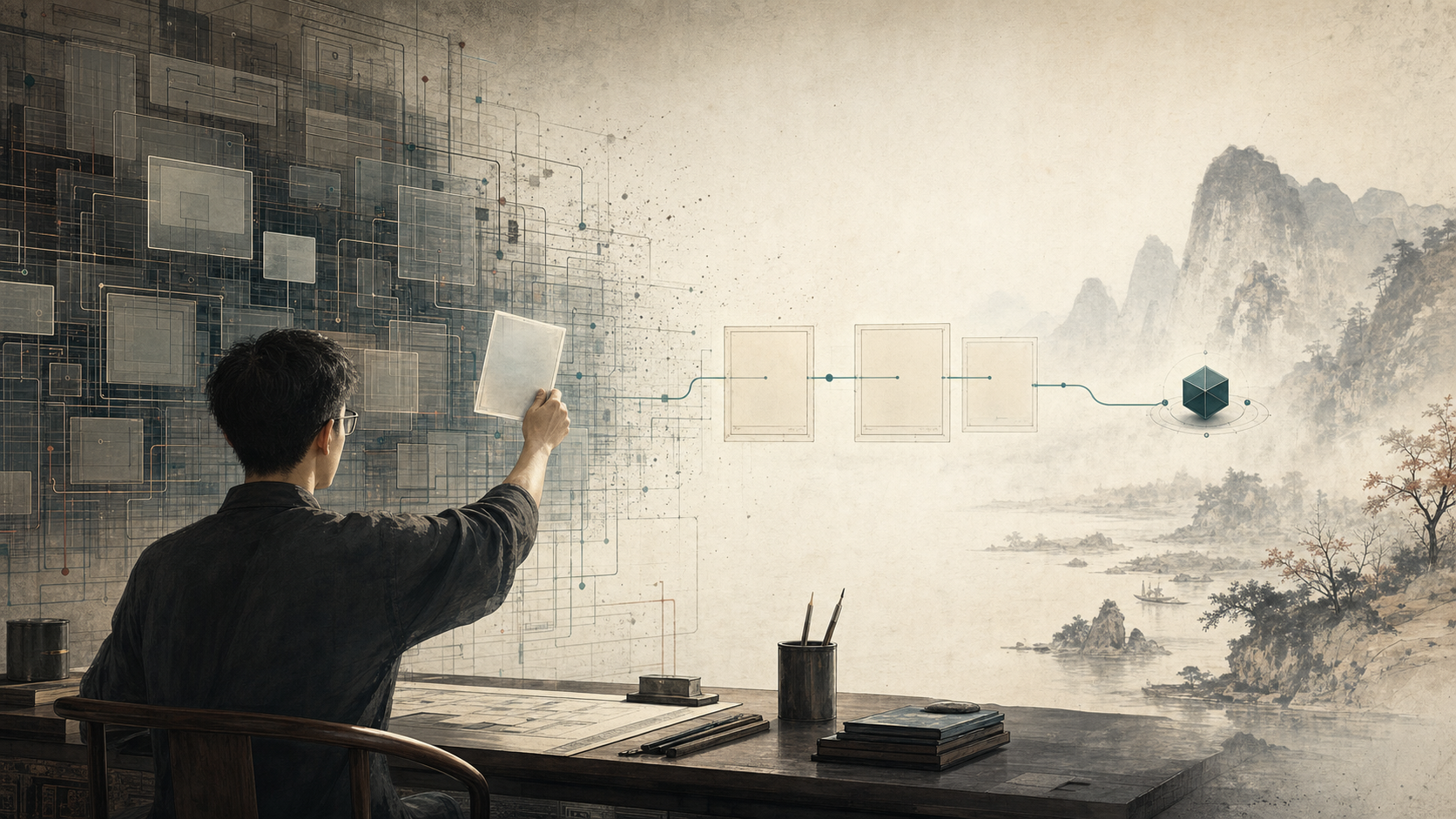
This suggests that before a structure becomes visible, a particular way of observing has already begun.
We do not first possess a pure eye and then look at the world. We always look from a position, through concerns, experience, bodily states, habits of language, and media environments.
This is the direction developed in JanusPath’s later supplementary paper, From Structural Reflection to Origin-Observation Reflection:
From structural reflection toward origin-observation reflection.
4. What Is Origin-Observation?
Origin-observation asks how a way of seeing rises and begins.
It does not ask, “What structure do I see?”
It asks, “Why do I see structure in this particular way?”
This step matters. We may believe we have already moved beyond surface content and discovered the deeper structure, while the “structure” we perceive is still shaped by our way of observing.
Someone accustomed to interpreting problems through power may see every relationship as control.
Someone oriented toward efficiency may see every obstruction as process waste.
Someone who has been hurt for a long time may perceive threat first in many neutral events.
An engineer may naturally seek interfaces, dependencies, boundaries, and coupling. A poet may first see symbols, emotions, and metaphors.
This is not a hierarchy of better and worse.
They are different ways of observing.
Origin-observation reflection brings that difference itself into reflection.
5. What Shapes the Way We Observe?
The origin-observation layer of JanusPath includes several important factors.
The first is situational momentum—shi (势).
This is neither fate nor mysticism. Think of it as a direction already taking shape within a situation.
If a company has long valued sales while neglecting engineering, people naturally explain emerging problems through performance pressure. If a team has lacked trust for years, any delay in communication can be interpreted as evasion. If a platform rewards extreme expression with traffic, moderate, complex, and careful voices become increasingly difficult to see.
These are forms of shi.
They do not make the judgment for you, but they make certain questions easier to ask and certain explanations feel more “natural.”
The second factor is concern.
People do not observe without reason. You see a problem because it matters to you in some way.
If you care about efficiency, you see processes.
If you care about fairness, you see distribution.
If you care about safety, you see risk.
Concern is not a flaw. Without concern, the world is only disordered information. The problem is that we often forget our concern is participating in observation.
The third factor is the formed mind—chengxin (成心).
The formed mind can be understood as an already established center of judgment. It is more than bias; it is a set of interpretive habits accumulated over time.
Before analysis even begins, a person may already know faintly what they want to prove, what they fear seeing, and what they are willing to believe.
The more sophisticated the model, the more effectively it may serve self-confirmation.
Origin-observation reflection therefore asks:
- What am I most eager to prove right now?
- What am I most afraid to see?
- If my position changed, would I still understand the problem this way?
- If my concern changed, would the structure I see also change?
These questions sound simple, but they are sharp.
They do not judge other people. They turn reflection back upon the self.
6. Why Draw on Daoist Thought Here?
The origin-observation layer draws on resources from Daoist thought, but it is neither religious nor an attempt to turn JanusPath into a mystical system.
Daoism functions here as a set of reminders.
First, language is not final truth.
Any concept, model, or term becomes a structure as soon as it is spoken. It helps us understand and also limits us in return.
JanusPath therefore cannot treat its own model as an endpoint. The model is an entrance, not the Dao itself.
Second, do not become attached to the medium.
Words, diagrams, methods, and tools can carry insight. Once insight occurs, however, we must not begin worshiping the medium. In the Daoist image of “forgetting the fish trap once the fish is caught,” the instrument used to catch the fish is not the fish itself.
Third, action is not forced reconstruction.
Daoist wuwei does not mean doing nothing. It means not allowing excessive will to destroy the conditions through which something can emerge.
Applied to JanusPath, seeing a structure does not grant us the right to redesign it arbitrarily.
Mature intervention sees where an opening is possible and opens there; where a knot exists and loosens there; where a boundary stands and adjusts there.
It is a more restrained and deeper ethic of action.
7. Reading the Two Papers Together
Read the two JanusPath papers together and a clear path of development appears.
The first step moves from content to structure.
Do not ask only “What happened?” Ask “Why did it happen in this form?”
The second step moves from structure to the way of observing.
Do not merely say “I see the structure.” Ask “Why do I see it this way?”
The third step moves from observation toward self-restraint.
Do not treat any model, language, diagram, or method as final truth. They are media that help us reflect.
In more ordinary language:
JanusPath does not only help you see the problem clearly. It helps you see how you began to see the problem.
That is the meaning of moving from structural reflection to origin-observation reflection.
8. A Small Exercise You Can Use Immediately
The next time you encounter a complex problem, do not rush into analysis.
First, complete four sentences:
- I currently see this problem as: ____
- I see it this way because I care about: ____
- From another position, it might become: ____
- This situation itself is pushing me toward the judgment that: ____
These statements are ordinary, but they pull you out of automatic reaction.
You may discover that many “problems” are partly products of a way of observing.
When the way of observing changes, structure appears differently.
When structure appears differently, action changes as well.
Conclusion: Real Freedom Begins by Seeing How You See
We often speak of thinking independently.
Independent thought is not simply having an opinion of your own.
Many “personal opinions” are echoes of environment, language, identity, emotion, and existing structure.
Real independence begins not by thinking faster or knowing more, but by asking as a thought arises:
Why do I see it this way?
Perhaps this is the meaning of JanusPath.
It does not promise a universal answer.
It takes you back to an earlier place: before the problem becomes a problem, before structure appears, before judgment lands.
That place is not empty.
It contains your concerns, position, experience, language, and body, as well as the momentum of the whole situation.
When a person can see this, they are no longer only someone shaped by structure.
They begin to reflect on structure, adjust observation, and choose another path.
This is not an escape from a complex world.
It is the recovery of sovereignty over observation within that world.
Further reading: