
Latest writing

Why I Started Simplifying My AI Agents
After intensive use of AI agents such as Codex and Claude Code, I began removing unnecessary skills, rules, and context. This article explains why more configuration is not always better and how restraint can make agents more reliable.

What You See Is Not the Problem Itself, but the Way It Becomes Visible
An accessible introduction to JanusPath's movement from structural reflection to origin-observation reflection: complex problems concern not only content and structure, but also how observation begins.

From Writing Code to Governing Agents: Software Engineering's New Question in the AI Era
As AI agents increasingly generate code, the engineer's core value is shifting toward extracting rules, designing constraints, maintaining context, and governing agents. The new production object of software engineering is executable experience, rules, and cognitive assets.
A Team SOP for Using Codex, OpenSpec, and Superpowers
A team-oriented Codex usage SOP covering OpenSpec, Superpowers, context preservation, requirements discovery, product planning, implementation, validation, operations analysis, troubleshooting, and knowledge handoff.

Team Atmosphere Is Not Culture; It Is Noise Management
Team atmosphere is shaped less by cultural slogans than by how leaders handle noise, deviation, and uncertainty. Beginning with an argument over an early food delivery, this article explains defensive work, degradation spirals, risk tiers, tolerance bands, and practical noise budgets.
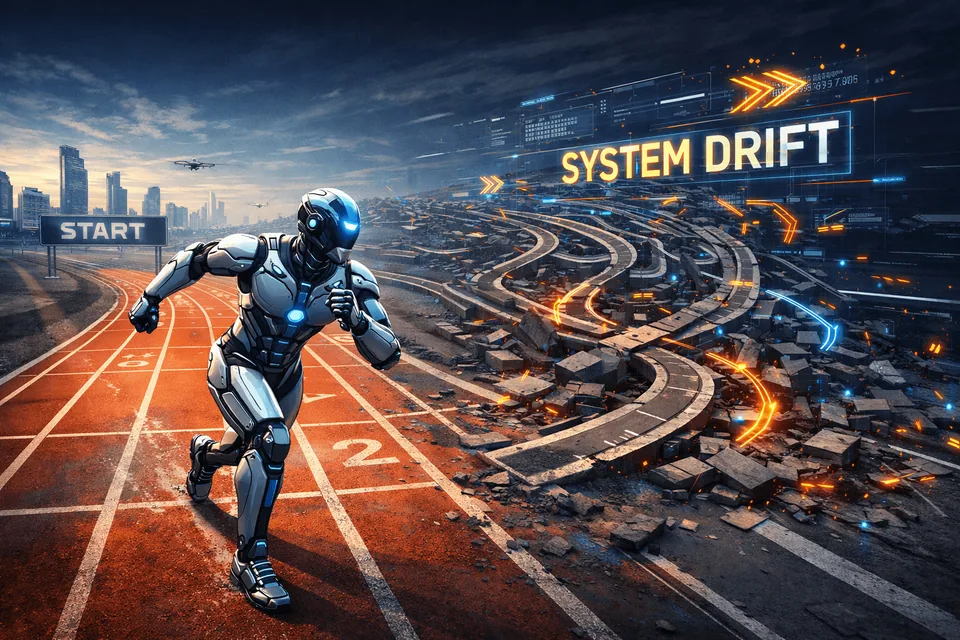
AI Agents Are Powerful, but They Drift
AI agents perform exceptionally well on short tasks, yet often suffer from semantic drift in long-running workflows. This article distinguishes context windows from persistent memory and argues that today's agents cannot reliably preserve system structure, leaving structural sovereignty in human hands.

If Humans Stop Writing Code, AI Will Get Worse Too
If most future code is generated by AI, models will increasingly learn from code written by other models. Small errors and poor structures may be copied until they harden into convention, degrading quality and contributing to model collapse. What improves a system is still human judgment about boundaries, trade-offs, and structure.

Structural Noise
During the city's Eighth-Round Order Optimization, an algorithmic ethics reviewer is classified as an unpredictable “structural noise point.” As identity, social access, and resources are stripped away layer by layer, he uses a performance of absolute loyalty to make the system downgrade itself and prise loose the anchor of its rules.

Inversion of Control Through a Structuralist Lens
This article steps away from implementation details to reinterpret Inversion of Control through structuralism. A dependency is fundamentally a power relationship, and IoC externalizes the right to decide. This lens connects dependency injection, configuration, low-code systems, and system evolution.

Software Engineering Is Full of Hidden Thinking Models
Software engineering is never purely technical. It is a practical exercise in structural thinking. Through modularity, architecture, debugging, and iteration, engineers have long practiced an unnamed philosophy.