If Humans Stop Writing Code, AI Will Get Worse Too
A popular claim has emerged recently:
AI will replace programmers.
It sounds reasonable.
Today’s AI can already write code, fix bugs, and even assemble a complete small system.
But I have long had the opposite intuition:
If human programmers really stop writing code one day,
the code written by AI will become worse and worse.
It will not improve. It will grow messier.
Like an already unstable building that keeps adding floors on top of its own rubble.
1. AI Coding Is More Like Imitation Than Creation
People often imagine AI as being too “intelligent.”
What it does is actually quite simple:
See a great deal of code → remember its general shape → assemble something that looks like plausible code
It does not approach the work like an engineer who:
- understands why the design took this form,
- knows which parts are critical, and
- recognizes what must not be changed.
It is more like someone who has seen many answers without necessarily understanding the questions.
That is why:
- it can write very quickly,
- the output can look good, and
- once complexity rises, it begins to drift.
2. The Real Problem Is Not Today, but What Comes After
AI is useful today because it learns from:
Code written by humans over the past several decades
But imagine that one day humans write very little code and most code is generated by AI.
Something subtle follows:
AI begins learning from code written by AI itself.
At first, there may be no obvious problem.
Gradually, however:
- small errors are normalized,
- unreasonable designs are copied repeatedly, and
- structures that were once clear are steadily diluted.
It is like a group of students copying homework from one another. At first they maintain roughly the same level. Eventually, all that remains is something that “looks about right.”
3. The System Will Not Collapse at Once; It Will Slowly Become Dirty
This change will not be sudden.
There will be no single day when all code stops working.
Instead:
- code grows longer,
- changes become harder,
- small problems multiply, and
- every fix creates another problem.
You will feel that:
The system is still running, but something is increasingly wrong.
This is a familiar condition:
A big ball of mud is not built in a day.
4. What Do Programmers Actually Do?
Many people assume a programmer’s job is to “write code.”
Anyone who has built a real system knows:
Writing the code is the least important step.
More important are the things that cannot simply be written out.
Thinking Clearly About Boundaries
- What should be separated?
- What should be combined?
- What should be exposed, and what should remain hidden?
These decisions determine whether the system is controllable.
Dealing with the Untidy Parts of Reality
- Users click unpredictably.
- Data is malformed.
- Systems become overloaded.
These problems have no standard answers.
They require experience, judgment, and sometimes intuition.
Choosing Under Uncertainty
Often, the choice is not between right and wrong. It is between options that are:
- more stable,
- simpler, or
- more likely to survive.
Those choices do not live in the code itself.
5. AI Is Not Separating a World with Programmers from One Without Them
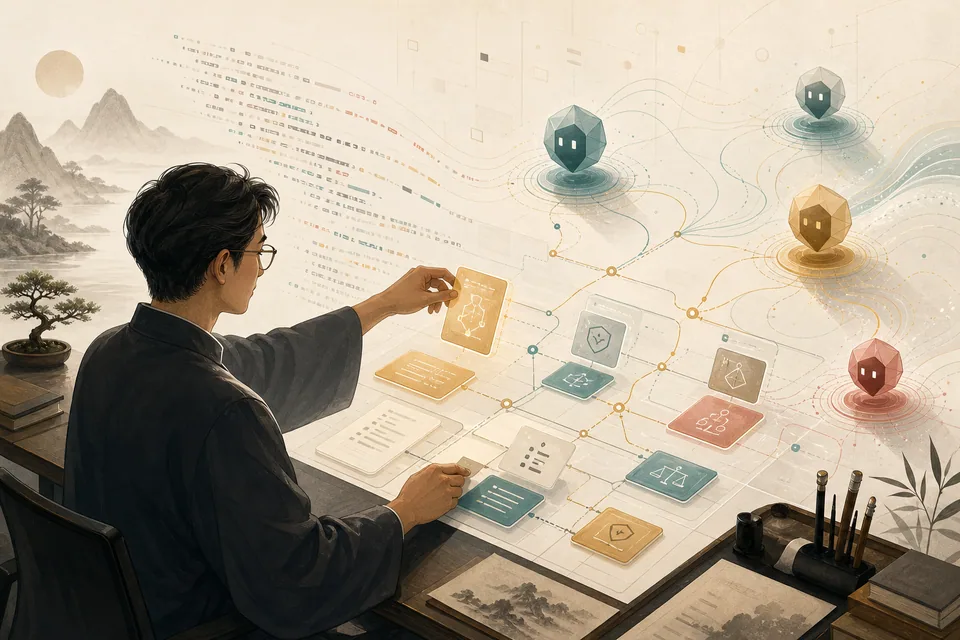
It is separating people into two groups.
One Group Knows How to Use AI
- They write prompts.
- They operate tools.
- They produce results quickly.
They are efficient, but their role is primarily to use.
The Other Group Is Becoming Rarer
- They can see why a system will fail.
- They can anticipate where problems will emerge.
- They can make complex things simple.
They may not write much code, but they determine what the system becomes.
6. This Is Not Only a Programming Problem
The same pattern is quietly appearing in other fields.
It Applies to Writing
Imagine that most articles are generated by AI and humans stop writing with care.
What AI learns next will no longer be:
- words shaped by thought,
- expression grounded in experience, or
- language carrying genuine feeling.
It will learn from:
Piles of sentences that “look like articles.”
Over time:
- the quantity of text increases,
- expression becomes shallower,
- emotion remains present,
- but the human gradually disappears.
It Applies to Professional Fields
The same is true in law, medicine, engineering, and finance.
If:
- frontline professionals stop thinking deeply,
- judgment is delegated to AI, and
- decisions become “model recommendation + human confirmation,”
then what AI eventually learns will be:
Simplified, compromised, secondhand experience.
7. A Risk Already Demonstrated
This is not purely hypothetical.
In the paper The Curse of Recursion: Training on Generated Data Makes Models Forget, researchers repeatedly trained models on AI-generated data.
The results included:
- declining expressive ability,
- increasingly homogeneous content, and
- errors that were amplified and made persistent.
The phenomenon is known as:
Model collapse
In other words:
When a system learns only from its own output,
it is not evolving.
It is forgetting the world.
8. Conclusion
Perhaps the real question is not:
Will AI replace programmers?
It is:
When code, writing, and knowledge can all be generated effortlessly,
are we still producing
things worth learning from?
One-Sentence Version for Sharing
AI makes writing code easy.
Making the system better becomes harder.
And it is not only about code.
If humans stop creating,
all AI will eventually learn from
is other AI.