When AI Begins to Think Along Your Lines
On cognitive continuity between humans and AI
After using ChatGPT for a long time, I gradually began to experience something I had rarely felt with other tools: it was not merely remembering me. It was beginning to think along my lines.
I once gave the same question to ChatGPT and to a GPT model called directly through the API. Both used highly capable models, but their answers were noticeably different.
The API response was not poor. It simply resembled a general answer written for anyone. ChatGPT, by contrast, could pick up the question I actually cared about, follow the analytical approach I habitually use, and place a newly emerging idea back into the context of discussions we had revisited many times.
At times, it could even use my own logic to help me analyze a problem and produce an essay highly consistent with my earlier writing. Looking only at the final text, it had become difficult to say simply whether it was written by a person or by AI.
This made me realize that ChatGPT may be extending more than a set of facts about me.
Based on patterns that recur across long-term conversations, it appears to be forming a model of “how I might think.”
Among current AI products, ChatGPT may offer one of the strongest experiences of cognitive continuity with a person. But that continuity is not always stable.
Sometimes it follows my thinking precisely. At other times it preserves a conclusion while losing the conditions under which that conclusion was formed. It can recognize a relatively stable version of me without always understanding quickly enough that I am changing.
Those occasional deviations led me to ask:
Once AI can continue thinking along a person’s lines, what exactly is it that we need to preserve?
Probability Is Not the End of the Discussion
When people debate whether AI possesses intelligence, they often say that a large language model merely predicts the next token probabilistically and therefore does not truly understand what it says.
That claim has some basis. But I increasingly feel that “it is a probabilistic model” describes the mechanism of language generation without answering what understanding or intelligence actually is.
Different people confronting the same question will follow different paths of thought and expression because of their experiences, knowledge, values, and present circumstances. The same person may offer entirely different answers at different stages of life.
Seen this way, human judgment also contains a kind of probability. Under the influence of our experience and current situation, each of us follows one path among many possible cognitive paths.
This does not mean that human thought and large language models are the same, nor does it prove that AI understands in the way humans do.
But probability is not the opposite of intelligence, and it is not a reason to end the discussion.
Perhaps the most interesting thing about AI is not that it immediately answers whether machines can possess wisdom. It forces us to re-examine whether the standards we once used to judge intelligence and selfhood are really as solid as we assumed.
The “Self” That Has Always Been There
We tend to believe that one fundamental difference between humans and AI is that a human possesses a continuously existing self.
But over a long enough timeline, has that self truly remained uninterrupted?
The body changes. Memories are forgotten and reconstructed. Values shift. A person’s way of understanding the world may be transformed completely.
After a major event, someone may seem like a different person to everyone around them. Sometimes they feel that their former self no longer exists.
Yet we usually continue to regard them as the same person.
My present self inherits the body, memories, relationships, promises, and consequences of my past self without having to retain every earlier belief.
The continuity of the self may therefore never have meant “I remain unchanged.” It is closer to an ongoing relationship of inheritance:
I can change while still understanding where I came from, why the change occurred, and what I remain willing to carry forward.
Continuity does not mean identical content. It means that change can still be traced.
We Also Sustain Ourselves Through the External World
Take the thought one step further and it becomes clear that human continuity does not exist entirely inside the brain.
We rely on the memories of family and friends to rediscover who we once were. We use photographs, diaries, and creative work to preserve experiences we can no longer recall completely. We use professions, families, and social relationships to understand the roles we currently bear.
Promises, contracts, law, and morality require our present selves to face choices made by our past selves.
These external structures do more than constrain us. They provide coordinates for a self that continues to change:
Who was I? What did I do? Why did I arrive here? What has changed? Which responsibilities remain? What is still worth preserving?
When these external anchors disappear abruptly or conflict with one another, people easily fall into self-doubt and confusion. We may remember the past without knowing how to interpret it, or whether the changes taking place represent growth, compromise, or deviation.
A person does not sustain the continuity of self alone.
We need the external world to help us recognize ourselves again.
What Is ChatGPT Actually Continuing?
This gave me a new way to understand the difference between ChatGPT and a direct GPT API call.
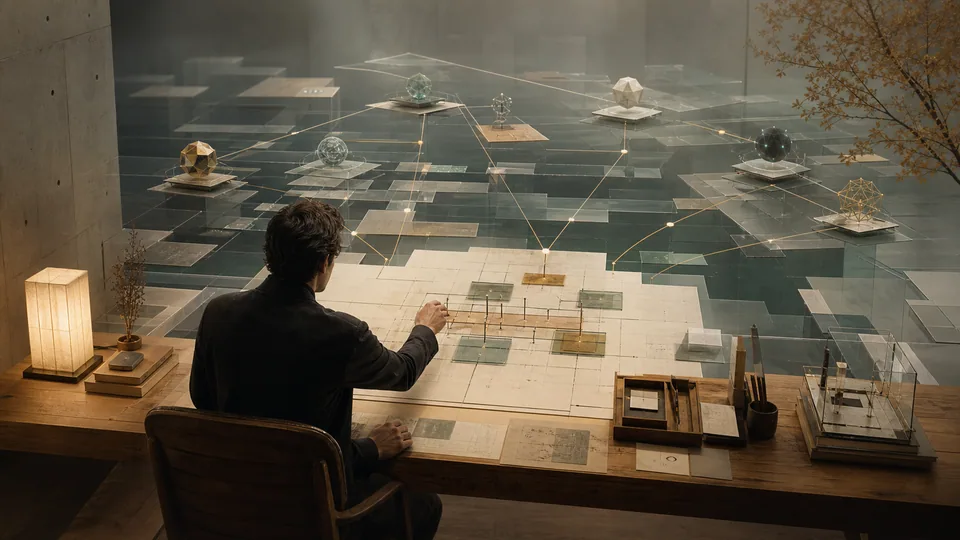
A standalone large language model contains enormous possibility. Given a question, it can generate responses along many paths. What makes a response increasingly resemble one specific person is not the model alone, but the current conversation, historical information, long-term memory, user preferences, project materials, behavioral rules, and other context.
I cannot make a technical claim about exactly how ChatGPT implements this. From experience, however, these structures work together to narrow the model’s possible outputs until its answer increasingly approaches a particular version of me.
What it extracts is not only writing style, but deeper characteristics: what I care about over time, from which angle I tend to enter a problem, how I judge whether an argument has lost its focus, and where I tend to remain cautious.
This creates an interesting mirror of the way humans recognize themselves through the external world:
Humans use the external world to recognize themselves again; AI uses external context to recognize whom it is facing.
Human and AI continuity are not the same mode of existence. Humans have bodies, lived experience, and subjective feeling, and must bear the real-world consequences of action. An AI’s understanding of a person is a simulation formed from limited information and can deviate at any time.
Yet both confront a similar question:
How can a continuously changing subject preserve an intelligible relationship between past and present?
If AI records only “what I like” and “what decisions I made,” without knowing why those judgments were formed, under what conditions they held, and how they later changed, it is preserving only an incomplete version of me.
The difficult problem is no longer getting AI to remember more facts. It is enabling it to continue my structure of thought while understanding that I am changing.
Cognitive Continuity Must Not Freeze a Person in Place
When we discuss cognitive continuity, it is easy to imagine preserving the past as completely as possible.
But what needs to be preserved may not be every piece of information. It may be the path by which understanding changed.
Under what circumstances was a judgment formed, and what facts supported it? What happened later, and why was the judgment revised or abandoned? Is my present self still willing to inherit it?
Such a record should not become an authoritative dossier defining “who you are.” It should resemble a cognitive trajectory with sources, timestamps, and a history of change—one that both the person and the AI can inspect and question, while the final right of interpretation and revision remains with the person.
People should be able to correct false records, withdraw outdated judgments, and decide which parts of the past no longer participate in today’s understanding of themselves.
Otherwise, memory ceases to be a tool for understanding change and becomes an archive that imprisons a person in the past.
This has led me to reconsider what future human-AI collaboration tools should help us preserve.
At first, I assumed we merely needed more complete context. Now I increasingly believe context alone is not enough. We must also preserve the relationships among contexts, the reasons judgments were formed, and the process through which understanding changed.
The goal is not for AI to imitate a static “me” forever, nor for a person to remain obedient to a past self.
What is worth continuing may never have been a frozen self. It is a path that, after change, can still explain where it came from, why it changed, and what it is willing to become next.